
AI in Education USA 2026: How Artificial Intelligence is Transforming American Classrooms

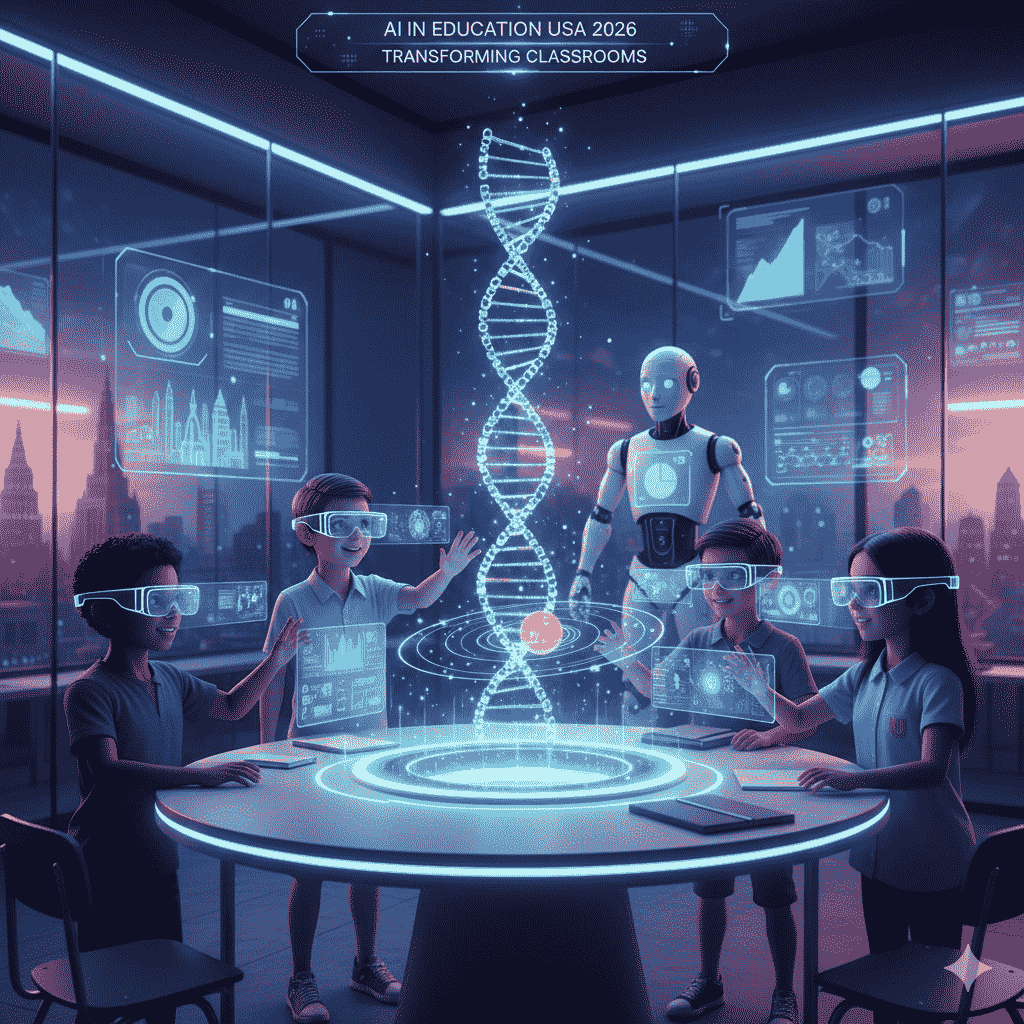
AI in Education USA 2026 is no longer just a futuristic idea—it is a powerful reality reshaping schools across the nation. From elementary schools in California to high schools in Texas and universities in New York, AI in Education USA 2026 is changing how students learn, how teachers teach, and how institutions operate.
With federal initiatives, private sector investments, and state-level innovation, AI in Education USA 2026 is redefining classroom experiences at every level.
As technology advances rapidly, AI in Education USA 2026 stands at the center of America’s educational transformation.
In 2026, artificial intelligence is not replacing teachers—it is empowering them.
It is personalizing instruction, automating administrative tasks, improving accessibility, and helping educators make data-driven decisions that boost student achievement.
What is AI in Education?
Artificial Intelligence (AI) in education refers to the use of intelligent systems that simulate human thinking processes—such as learning, reasoning, and problem-solving—to enhance educational experiences. These systems include:
- Machine Learning (ML)
- Natural Language Processing (NLP)
- Predictive Analytics
- Intelligent Tutoring Systems
- AI-powered assessment tools
In the United States, AI integration has expanded significantly since 2023, especially with the rapid adoption of generative AI tools.
Why AI in Education USA 2026 is a Game-Changer
The American education system serves over 50 million K-12 students and nearly 20 million college students. Managing such a vast ecosystem requires innovation.
AI offers scalable solutions to long-standing challenges like:
- Achievement gaps
- Teacher workload
- Student engagement
- Special education support
- College readiness
AI-driven platforms now analyze student performance in real time, predict learning difficulties, and suggest personalized interventions before students fall behind.
Personalized Learning at Scale
One of the most powerful impacts of AI in Education USA 2026 is personalized learning.
Adaptive Learning Systems
AI-powered adaptive learning platforms adjust content difficulty based on individual student performance. Instead of a one-size-fits-all approach, students receive customized lessons tailored to their learning pace.
For example:
- Struggling math students get additional practice with step-by-step guidance.
- Advanced learners receive enrichment content automatically.
This personalization boosts retention and improves test scores across subjects.
AI-Powered Tutoring Systems
AI tutors are available 24/7, providing instant support. Students no longer need to wait for classroom hours to get help.
These systems:
- Explain complex topics in simple language
- Provide instant feedback
- Generate practice questions
- Offer multilingual support
In states like California and Florida, AI tutoring platforms are integrated into public school systems to support underperforming districts.
Generative AI in American Classrooms
The rise of generative AI has revolutionized lesson planning and content creation. Tools inspired by models like those developed by OpenAI are widely used in schools and universities across the U.S.
How Teachers Use Generative AI
- Creating lesson plans
- Designing quizzes and worksheets
- Generating reading comprehension passages
- Drafting feedback for student essays
This reduces teacher burnout and saves hours of preparation time weekly.
AI in Higher Education USA 2026
American universities are leading AI integration. Institutions like Harvard University and Stanford University are incorporating AI literacy into their core curricula.
Key Transformations in Colleges
- AI-assisted research analysis
- Automated grading systems
- Predictive analytics for student retention
- AI-driven career counseling
Universities are also using AI to detect academic dishonesty while maintaining ethical standards.
AI and Special Education
AI is improving accessibility for students with disabilities.
Assistive AI Technologies
- Speech-to-text tools for hearing-impaired students
- Text-to-speech readers for visually impaired learners
- Real-time translation systems for ESL students
- Emotion recognition tools for autism support
AI ensures inclusive education, aligning with federal mandates for accessibility.
Federal Policies Supporting AI in Education USA 2026
The U.S. Department of Education has released guidelines promoting responsible AI usage in schools. Federal funding supports AI research, teacher training, and digital infrastructure.
Public-private partnerships are strengthening AI adoption nationwide. Technology companies collaborate with school districts to implement ethical AI systems while protecting student data privacy.
AI and Data-Driven Decision Making
School administrators now use AI dashboards to analyze:
- Attendance patterns
- Test performance trends
- Dropout risk predictions
- Resource allocation efficiency
Predictive analytics help identify at-risk students early, enabling timely interventions.
Teacher Empowerment Through AI
Contrary to fears, AI is not replacing teachers—it is enhancing their role.
Teachers now spend:
- Less time grading
- More time mentoring
- More time designing engaging activities
- More time focusing on student well-being
AI acts as a co-pilot, not a substitute.
Challenges of AI in Education USA 2026
While AI offers transformative benefits, challenges remain:
- Data Privacy Concerns
Schools must comply with FERPA regulations to protect student information. - Algorithmic Bias
AI systems must be trained responsibly to avoid reinforcing inequalities. - Digital Divide
Not all districts have equal access to high-speed internet and advanced devices. - Academic Integrity
Balancing AI assistance with independent learning is crucial.
Ethical AI Implementation in American Schools
Ethical frameworks emphasize:
- Transparency
- Accountability
- Human oversight
- Student consent
Schools are developing AI usage policies that clarify acceptable and responsible use.
AI and STEM Education Growth
AI is driving interest in STEM careers. Coding, robotics, and AI literacy programs are expanding across U.S. schools.
States like Texas and Massachusetts are investing heavily in AI-focused curriculum reforms to prepare students for the future workforce.
Workforce Preparation and Career Readiness
AI in Education USA 2026 aligns with workforce demands. Students learn:
- Data analysis
- Machine learning basics
- Digital literacy
- Ethical AI usage
This prepares graduates for high-demand tech careers across industries.
AI in Standardized Testing
AI-powered assessment tools provide:
- Instant scoring
- Detailed performance analysis
- Skill-based insights
Standardized tests are becoming more adaptive and personalized.
Future Outlook: AI in Education Beyond 2026
The future includes:
- Fully AI-integrated smart classrooms
- Augmented reality (AR) combined with AI
- Emotion-aware learning platforms
- AI-driven curriculum design
Education in America is shifting toward hybrid, technology-enhanced learning ecosystems.
AI in Education USA 2026 represents a historic transformation in American classrooms. By personalizing learning, empowering teachers, enhancing accessibility, and preparing students for the digital economy, AI is reshaping the educational landscape nationwide.
While challenges such as privacy and equity must be addressed carefully, the opportunities far outweigh the risks. With responsible implementation, AI will continue to strengthen the U.S. education system and secure America’s leadership in innovation and knowledge.
FAQ – AI in Education USA 2026
- What is AI in Education USA 2026 and why is it important?
AI in Education USA 2026 refers to the integration of artificial intelligence technologies in American schools and universities to enhance teaching, learning, and administrative processes. It is important because it enables personalized learning, automates grading, improves accessibility, and prepares students for future tech-driven careers in the U.S. workforce.
- How is AI transforming American classrooms in 2026?
AI is transforming American classrooms by introducing adaptive learning platforms, AI tutoring systems, real-time performance analytics, and automated assessment tools. Schools are using AI to customize lessons based on student performance, helping close achievement gaps across different states.
- Is AI replacing teachers in US schools?
No, AI is not replacing teachers. Instead, AI supports educators by reducing administrative workload, automating grading, generating lesson plans, and providing data insights. Teachers remain central to classroom instruction, mentorship, and student engagement.
- What are the biggest challenges of AI in Education USA 2026?
The main challenges include student data privacy concerns, algorithm bias, the digital divide between districts, and maintaining academic integrity. U.S. schools must follow federal regulations like FERPA while implementing ethical AI policies.
- How does AI prepare students for future careers in the United States?
AI helps students build skills in coding, data analysis, digital literacy, and problem-solving. With AI integrated into STEM programs, students gain practical experience that aligns with high-demand careers in technology, healthcare, finance, and engineering sectors across the USA.
One Reply to “AI in Education USA 2026: How Artificial Intelligence is Transforming American Classrooms”